Emotional Wellbeing
How to stop overthinking when your mind won't let it go
Going over it one more time feels like working on it. Usually it isn't. Why the loop starts, why it gets louder at night, and small ways to interrupt it.

It's 1:14am. You said one slightly odd thing in a meeting on Tuesday, and you've now replayed it more times than anyone in that room will ever think about it.
You've rewritten your answer twice. You've also drafted the email you won't send.
Part of you knows this isn't helping. Another part is sure that if you stop now, you'll miss the thing you were meant to figure out.
Why does overthinking feel so productive?
Because it looks like work. An hour of it leaves you as tired as an hour of real effort, so it's easy to believe something got done.
Psychologist Susan Nolen-Hoeksema spent much of her career on this loop, which researchers call rumination. She found that going over a problem again and again isn't problem-solving, and more time doesn't turn it into problem-solving. It reliably makes your mood worse while feeling useful, which is exactly why it's so hard to leave.
She also found that women ruminate more than men on average. She saw that as a matter of training and circumstance, and never as a matter of capacity. If you grew up as the one who noticed everyone's mood before they said a word, you already know where the habit came from.
Is it overthinking or problem-solving?
Problem-solving moves. Each pass leaves you with something new, even if it's only a question you can ask someone tomorrow.
Overthinking circles.
The same scene comes back in the same words, and the only thing that changes is how bad you feel.
So when you catch yourself in it, ask: have the last 10 minutes given me anything I can do? If the answer is no, you stopped working on it a while ago. You're rehearsing it now.
The Life Portrait
Does your mind keep circling back to the same part of your life?
Free · about 6 minutes · 87 cards · all 7 areas of your life
Start the Life PortraitWhy is overthinking worse at night?
During the day something always cuts in. At 1am nothing does, and the thought gets the whole stage to itself.
Your body plays a part too. Emily and Amelia Nagoski point out that a stressor and the stress it caused are 2 separate problems.
The meeting ended on Tuesday, but the stress it set off can still be sitting in your body. A mind lying still in the dark goes looking for a reason.
So 1am feels certain. Nothing new has happened since lunch, and somehow the problem has doubled in size.
What doesn't work
You've probably told yourself to stop thinking about it. Notice how well that went. Pushing a thought away tends to hand it more attention.
Talking it through with a friend helps for an evening. Talking the same worry through every night with the same friend can keep the loop going, only now with company.
What can you do instead?
Arguing with the thought rarely wins, so none of these try. They change where the thought sits, or they give your body the signal your mind is waiting for. Pick one and try it this week.
Write the worry down, then write the next step
Circles are much harder to run on paper. Write the worry in one sentence. Under it, write the one thing you could actually do about it, and when.
If there's nothing to do, write that too: "Nothing to do until Monday's meeting." Seeing it in your own handwriting tells your mind the problem has been filed somewhere safe.
Give the worry a time slot
Choose 15 minutes in the early evening as your worry time, same time each day. When the loop starts at 1am, tell it, "Not now. 6:30 tomorrow."
It sounds too simple. But a lot of late-night worrying is fear of forgetting, and a booked slot answers that fear.
Notice the thought as a thought
A technique from acceptance and commitment therapy, called defusion, adds a few words to the front. Instead of "I embarrassed myself," you say, "I'm having the thought that I embarrassed myself."
It feels a little silly the first time. Then you notice you're watching the thought from a step back, which is a much easier place to stand than inside it.
Finish what your body started
If the loop is louder after hard days, part of it may be stress your body hasn't finished with. The Nagoskis name 6 things that help complete it: movement, breath, connection, laughter, crying, and creative expression.
A 20-minute walk after a bad meeting often does more than a 2-hour replay of it.
The question underneath the loop
Most overthinking comes back to one question. Am I still okay with these people?
The loop promises that one more pass will settle it. It won't, because thinking can't reach back and change a moment that's already over. At some point you get to decide you've looked at it enough, and put it down while it still feels unsettled.
If you'd like to go further, this is the ground Inner Calm covers. Its third lesson, The Hour Nothing Is True, is about why 1am lies to you, and the 10 minutes that quiet it.
The Life Portrait
Find out which area of your life your mind keeps returning to.
Free · about 6 minutes · 87 cards · all 7 areas of your life
Start the Life PortraitCommon questions about overthinking
Is overthinking a sign of anxiety?
Almost everyone overthinks sometimes. It can also be part of an anxiety disorder, and only a doctor or therapist can tell you which it is. If the worry fills most of most days, or it comes with panic attacks, that's worth a real conversation with a professional.
Why do I replay conversations in my head?
Usually some part of you is checking whether you're still okay with the other person. It's an early-warning system working overtime. The replay rarely finds anything new, which is a good cue to put it down.
How long does it take to stop overthinking?
There's no fixed timeline, and the aim isn't to never overthink again. What usually changes first is how fast you notice the loop. Catching it after 5 minutes instead of an hour is real progress.
When it's more than overthinking
A loop that keeps you up now and then is common. If you've felt flat or hopeless most days for 2 weeks or more, or ordinary days have become hard to manage, please see a doctor or therapist. Coaching works well alongside that kind of support, and it isn't a substitute for it.
If your thoughts turn to hurting yourself, call or text 988 (US) at any hour. It's free and confidential. There's more on where to find help on our support resources page.
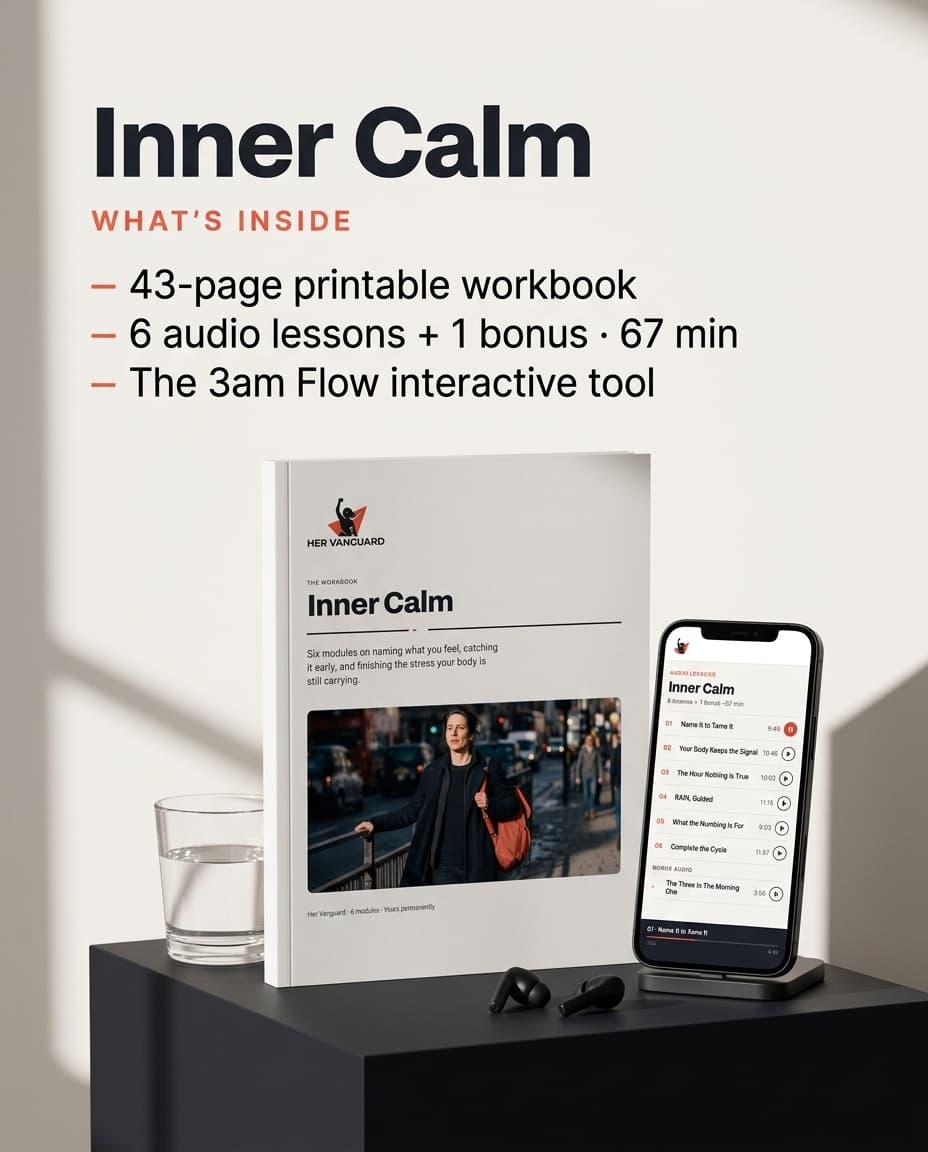
$97 · one payment, yours permanently
Digital program: a printable workbook, audio lessons and an interactive tool in your account.