Self Confidence
How to stop doubting yourself when you're good at what you do
Self-doubt rarely means you're bad at something. It usually means you haven't collected the proof yet. Where it comes from, and a few small ways to start.

You rewrote a two-line email 5 times this morning. Then you added "Sorry to bother you" at the top, deleted it, and put it back.
The email was fine. You're good at this job, and some part of you knows that. Another part was sure that one wrong word would show everyone what you really are.
Why do you doubt yourself even when you're capable?
Psychologist Albert Bandura spent decades on what makes a person believe she can do something. The strongest source by far is having done something like it before. Being told you can comes a distant third.
He also found that this belief builds separately in each area of life. You can be steady in a family crisis and shaky in a Monday meeting, and the only real difference between the two is how many reps you've had.
Pauline Clance and Suzanne Imes named the impostor phenomenon while studying high-achieving women, people who felt like frauds despite real evidence of skill. It tends to flare up in new rooms, especially rooms that weren't built expecting you.
Rate it, area by area
Score your confidence from 1 to 10 in each of these before you read on: your work, your body, your relationships, money, and speaking up.
Now look at the spread. Most women find a low score or two sitting next to a high one.
Keep the high one in mind. It means you already know how confidence feels somewhere, and the low area is mostly short on practice.
The Life Portrait
Your confidence isn't one number. See which area is pulling the rest down.
Free · about 6 minutes · 87 cards · all 7 areas of your life
Start the Life PortraitWhy don't pep talks work?
Look again at Bandura's list. Encouragement sits third, and it's weak.
That explains the friend who tells you you're amazing, and the feeling that has faded by Tuesday. She's right about you. Her words can't do the job your own evidence does.
Affirmations hit the same wall. Saying "I am confident" to a mirror asks you to believe something you have no proof for yet.
Waiting to feel ready has the order backward. Confidence mostly follows action, and it rarely shows up first.
What helps you trust yourself again?
Each of these gives your doubt something solid to argue with. Pick one for this week.
Catch the move your mind is making
Aaron Beck and David Burns described the specific wrong turns thinking takes under pressure. Mind-reading is one: "They all think I'm out of my depth." Another is discounting the good: "That went well, but anyone could have done it."
Give the thought its name when you catch it. Once it has a name you can argue with it. Until then it feels like the plain truth.
Start an evidence file
Keep a running list of things you've done that went well. There's one rule, and it matters: only write down facts a stranger could check.
"I'm good with clients" doesn't count. "The client renewed for another year" does. On a bad day your mind can wave away the first in a second, and the second is much harder to wave away.
Take a smaller step
If the thing you're avoiding feels too big, break it down until one piece is small enough to do today, nervous or not. If speaking up in meetings is the goal, the first step might be one question in a meeting where little is riding on it.
Before you do it, write down what you expect to happen. Afterward, write down what did. Often the second line is milder than the first, and seeing that in your own writing a few times does more than any pep talk.
Be kinder on the day you did get it wrong
The evidence file answers false accusations. Some days the criticism is fair, and you did drop the ball.
Kristin Neff's research separates self-compassion from self-esteem. Self-esteem is how highly you rate yourself. Self-compassion is how you treat yourself when you fail, and it holds up better in a bad week.
Many women worry that going easy on themselves will make them lazy. Juliana Breines and Serena Chen tested that. People who were kind to themselves after a failure tried harder and longer than people who criticized themselves.
What if the problem isn't you?
Sometimes you aren't underconfident at all. You're being talked over, or held to a standard nobody else in the building has to meet.
Inner work can't fix that kind of room. It can help you tell the two apart, which takes a surprising amount of weight off.
You won't need to think you're wonderful for any of this to work. You'll need to stop putting yourself on trial every time you hit send.
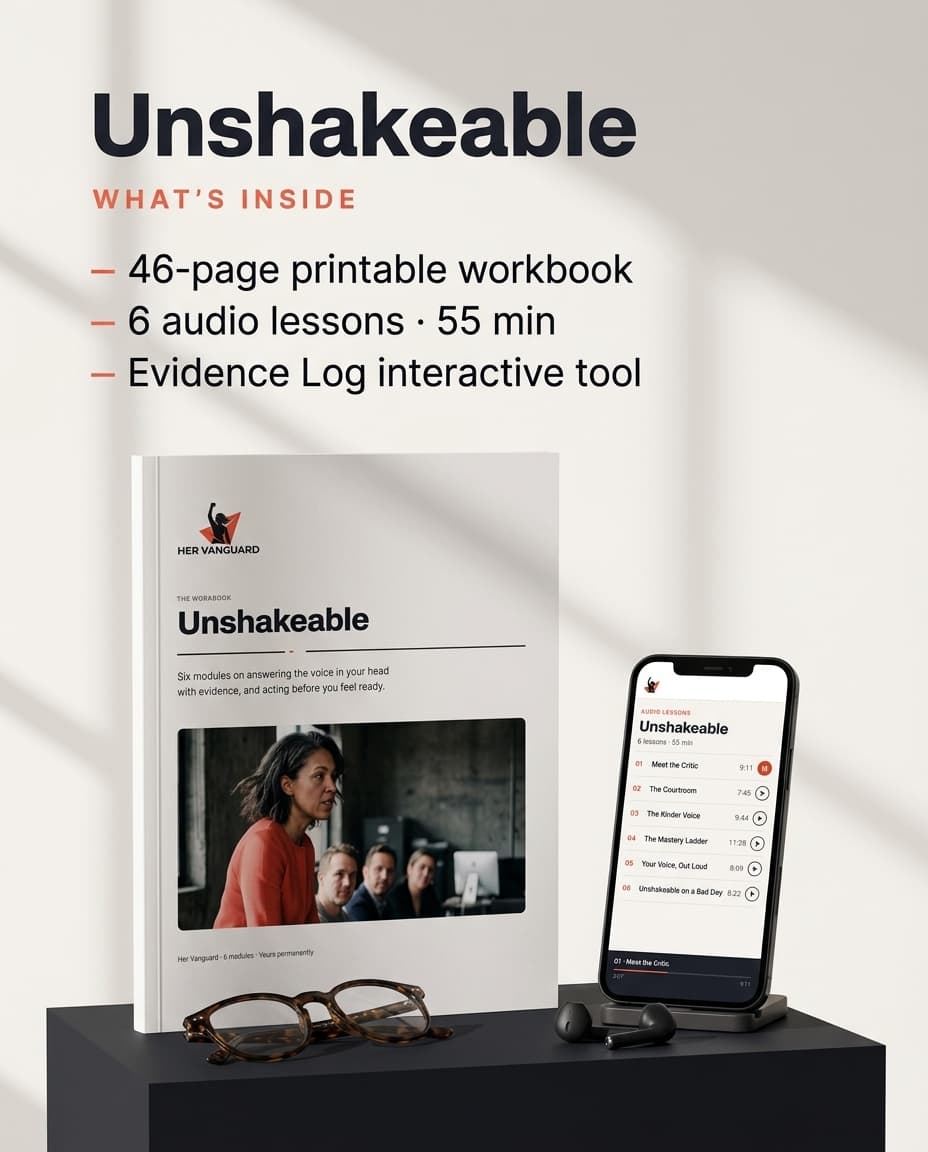
If you'd like to go further, this is the work Unshakeable is built on. Its second lesson, The Courtroom, builds your evidence file around that one rule: only facts a stranger could verify.
The Life Portrait
Find out where your confidence is strongest, and where to start.
Free · about 6 minutes · 87 cards · all 7 areas of your life
Start the Life PortraitCommon questions about self-doubt
Is self-doubt the same as impostor syndrome?
They overlap. Self-doubt is questioning whether you can do something. The impostor feeling is believing you've already fooled people, despite real evidence that you're capable.
Can you stop doubting yourself completely?
Probably not, and you don't need to. What changes is how long the doubt gets to make your choices, and how fast you recover after a hard day.
Why do I doubt myself at work but not at home?
Because confidence builds area by area. You've had years of practice in one place and less in the other, and practice is the part you can add to.
When it's more than self-doubt
If fear is keeping you from work or from seeing people, please talk to a therapist, before or alongside any coaching. Fear that size deserves real support, and needing it isn't a failure.
If the critical voice has turned into thoughts of not wanting to be here, call or text 988 (US), any hour, free and confidential. You'll find more places to get help on our support resources page.
$97 · one payment, yours permanently
Digital program: a printable workbook, audio lessons and an interactive tool in your account.