Career & Purpose
How to find your purpose when you honestly don't know what you want
Thinking harder about your purpose stopped working a while ago. Purpose is easier to measure and test than to find, and you can start with last week's calendar.

It's Sunday night and you're scrolling job listings for careers you don't even want. A friend asked you last week what you'd do if you could do anything, and you went completely blank.
You're not unhappy enough to quit. You're not happy enough to stop wondering, either.
Why can't you figure out what you want?
You probably had wants once. Then you spent years putting them second to the job and the family, and after a while you stopped noticing you were doing it.
So "I don't know what I want" often means something closer to "I know, and it feels unreasonable." Or "I knew once, and I haven't asked in a long time."
Thinking harder won't reach either of those. You've already done plenty of thinking.
Is purpose a destination or a direction?
Steven Hayes and the people behind acceptance and commitment therapy draw a helpful line. A goal is something you can finish. A value is a direction you head in, and it never runs out.
That matters for purpose. If purpose is one job title out there waiting to be found, you can miss it. If it's a direction, you can move toward it this week, in the job you already have.
Try this with last week's calendar
Write down 3 things that matter most to you in how you spend your time. Keep them short, like learning, being useful to someone, making things, or time with people you love.
Then open last week's calendar and count the hours that actually served each one.
Whatever gap you find is real information. It came from a week that already happened, so it's hard to talk yourself out of.
The Life Portrait
Is work really the area pulling on you, or is it something else?
Free · about 6 minutes · 87 cards · all 7 areas of your life
Start the Life PortraitWhat doesn't work
Quizzes that promise to name your calling feel good for an afternoon. Then you're back where you started, holding a label and no next step.
Waiting for passion to arrive first doesn't work well either. A lot of people come to love work after they've gotten good at it.
What helps you find a direction?
Track your energy for 1 week
Passion is slippery. Energy you can write down. For 7 days, note what left you with more energy than you started with, and what drained you.
Include the work that never shows up on a calendar, like remembering everyone's appointments and planning the week. It counts too, and it often explains why a week felt heavier than it looked.
Look inside the job you already have
Amy Wrzesniewski studied what she calls job crafting. People reshape their work from the inside, by leaning into certain tasks, changing who they work with, and changing how they see the point of it.
It changes how work feels without changing employers. Before you plan an exit, ask what one task you could do more of, starting Monday.
Sketch 3 different lives
Bill Burnett and Dave Evans suggest drafting several 5-year lives instead of agonizing over one. One continues what you're doing now. Another is what you'd do if this path disappeared, and the third is what you'd choose if money and opinions didn't matter.
You're not committing to any of them. Seeing 3 on paper makes the choice feel less like a cliff.
Run the smallest possible test
Pick one direction and try the cheapest version of it. Have coffee with someone who does that work, or spend one Saturday doing it.
If the test is wrong, it costs you an evening. If it's right, you'll have something better than a feeling to go on.
Is it a purpose problem or burnout?
Psychologist Christina Maslach found that burnout is made of 3 separate things: exhaustion, cynicism, and a fading sense that you're any good at what you do.
If your energy week comes out flat across the board, that may be depletion rather than the wrong direction. Rest and support come first. A new purpose won't land on an empty tank.
Sometimes the honest answer is the situation. No morning routine fixes a job that would drain anyone, and you aren't to blame for that.
If you'd like a guided version, this is the approach Purpose Map is built on. Its second lesson, Energy Is the Compass, walks you through those 7 days. It also covers how to read the week honestly if it all comes out flat.
The Life Portrait
Find out which area of your life needs you first.
Free · about 6 minutes · 87 cards · all 7 areas of your life
Start the Life PortraitCommon questions about finding your purpose
Is it too late to find my purpose?
No. Every year of work and life you've had is material to build with, including the parts that never came with a paycheck.
Do I have to quit my job to find my purpose?
Usually not. Many of the best tests can run alongside the job you have, and some of the change can happen inside it.
Can you have more than one purpose?
Yes. If you think of purpose as a direction, you can head in more than one at once, and the mix can change as your life does.
When it's more than a work question
If you've felt flat most days for 2 weeks or more, and it's everywhere rather than only at work, please talk to a doctor or therapist. Coaching works well alongside that support, and it isn't a substitute for it.
If you're having thoughts of not wanting to be here, call or text 988 (US) at any hour, free and confidential. And if what's going on at work is harassment or discrimination, that belongs with an employment lawyer or the agency where you live. There's more on our support resources page.
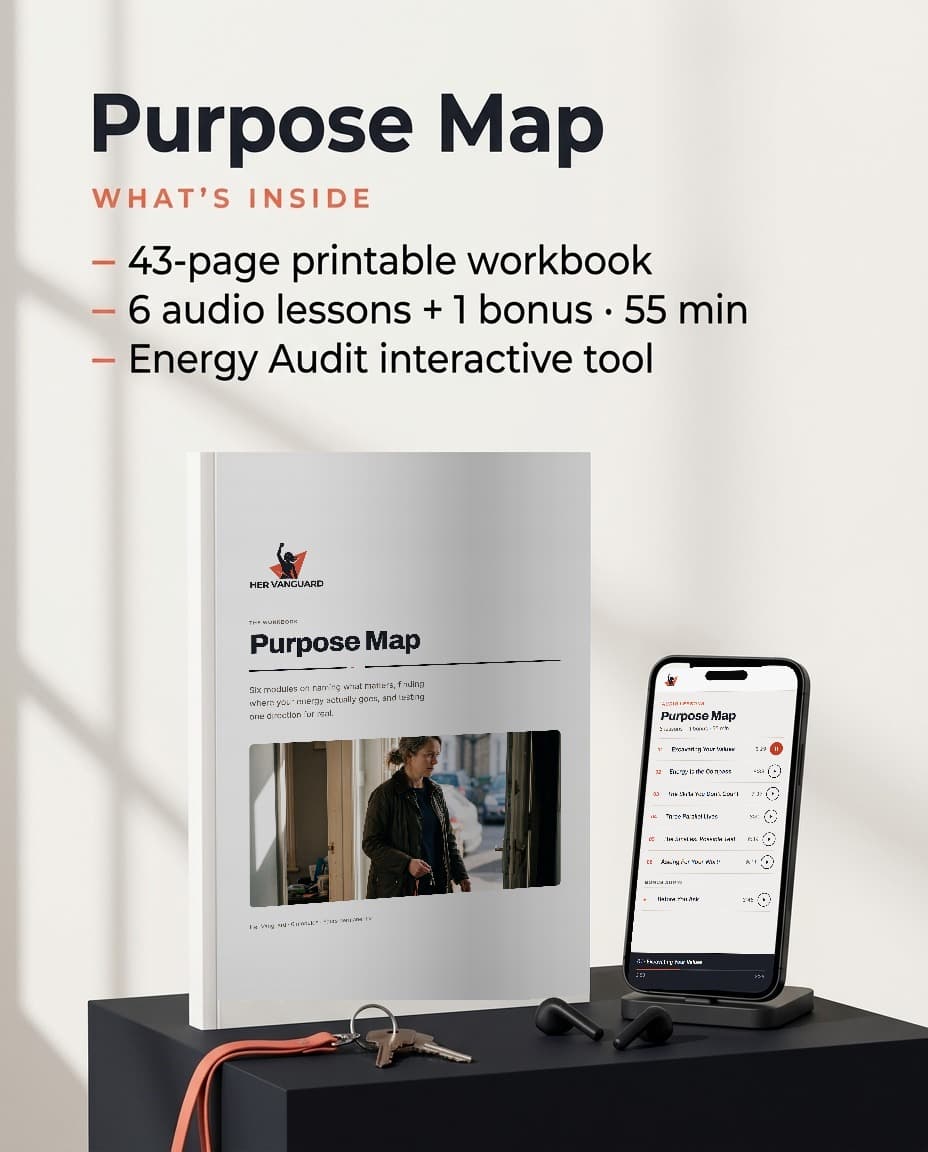
$97 · one payment, yours permanently
Digital program: a printable workbook, audio lessons and an interactive tool in your account.